
Two stars become one
November 19, 2026, 03:50 UTC.
A swollen giant star engulfed its smaller companion in the Andromeda galaxy, giving astronomers a rare chance to piece together how such a merger unfolds.
Researchers combined years of observations with data from the James Webb Space Telescope to reconstruct the event in a system nicknamed Bao. The team says a star slightly less massive than the sun spiraled into an aging supergiant and merged with it.
The result offers a direct look at a predicted stage of stellar evolution that is hard to catch because astronomers cannot easily know in advance when a pair will merge, according to the Space Telescope Science Institute and Columbia University, where lead author Viraj Karambelkar is a NASA Hubble Fellow.
Webb observed the aftermath of a star merger, helping astronomers piece together the fate of the pair.
— NASA Webb Telescope (@NASAWebb) November 18, 2026
How astronomers followed the event
In early 2023, the team noticed unusual brightening and dust in data from NASA’s NEOWISE mission. It continued watching with other instruments as the system changed.
Webb observed the aftermath 47 days after the eruption, Columbia said. Its infrared measurements helped researchers analyze dust shed by the larger star and compare their models with what telescopes saw. The findings appear in Nature.
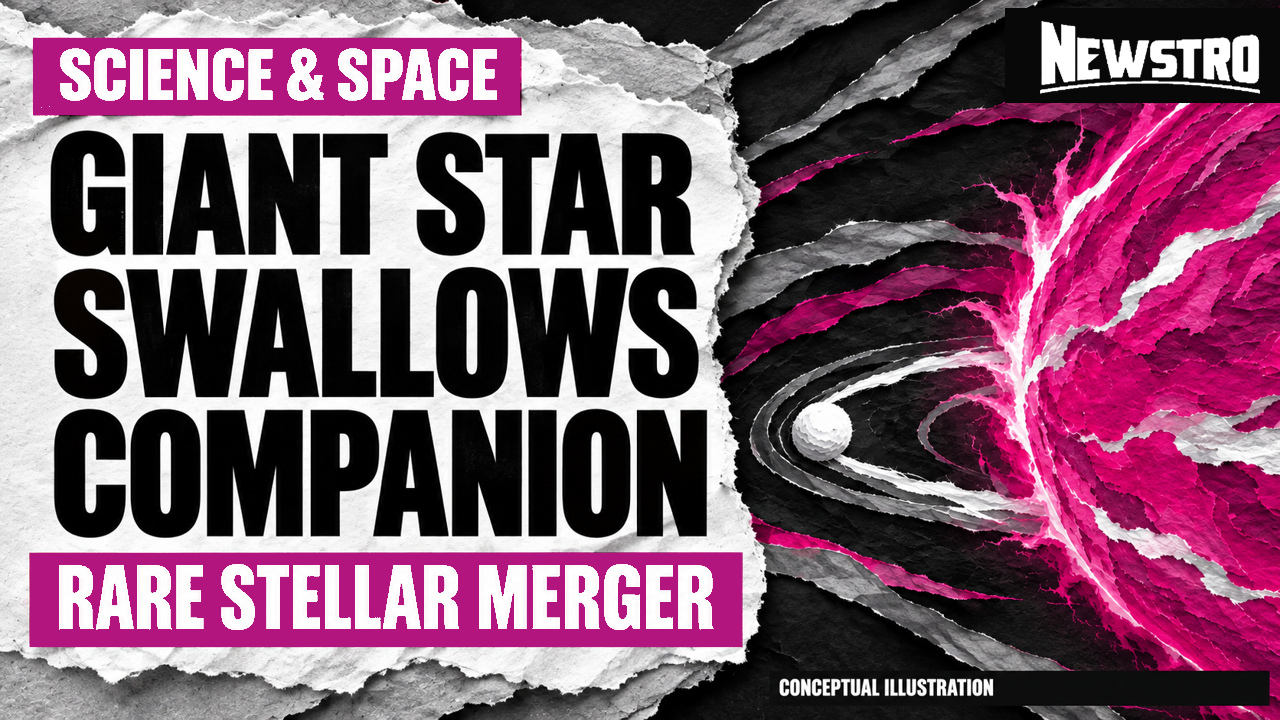
The proposed process is called common-envelope evolution: the smaller star moves through the larger star’s extended gas, losing orbital energy and spiraling inward. Other pairs can shed gas and survive as two tightly orbiting stars; in this case the team concluded the stars merged. The illustration accompanying this article is conceptual, not a photograph of the event.
Sources and visual credits
Reporting: Space Telescope Science Institute; Columbia University; NASA Webb Telescope on X; Nature research paper.
Visual: Conceptual editorial illustration; not a photograph of the event.